
Derelict Nets as Proxy Predators*
Commercial fishing fleets routinely dump thousands of tons of plastic pollution into the ocean because they are too costly to retrieve.
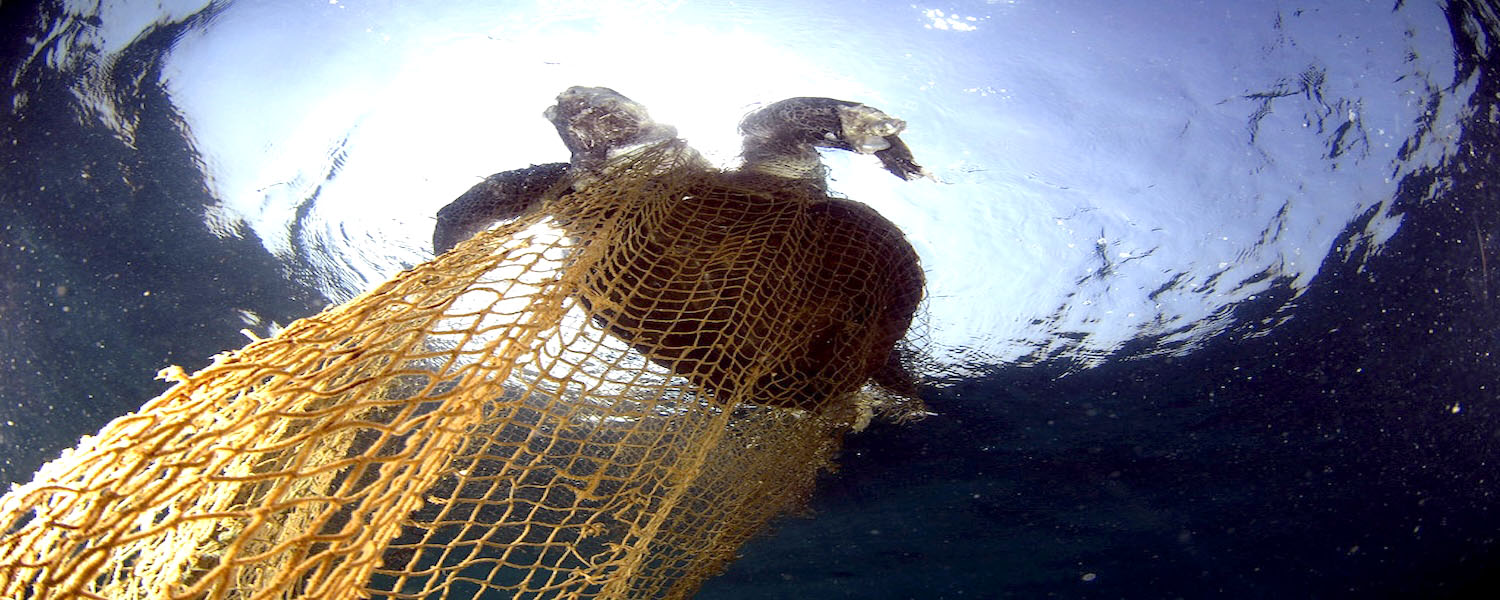
Discarded nets drift water columns and trundle across seabeds in lethal veils and clumps. Along their journey, they damage reefs and seagrass meadows, and injure or kill whales, turtles, sharks and other marine animals for decades. Though known as ghost nets, the impact of abandoned fishing gear in the ocean is far from spectral. They are the most dangerous form of marine debris[i] –the fishing industry’s’ proxy predator.
Figures vary as to just how much ghost gear is dumped into the ocean annually. One study has found that, in 2018, industrial fishers dumped or lost an estimated 100,000 tonnes of derelict nets into the ocean.[ii] The authors acknowledge that the total is likely to be significantly more because nets discarded by small scale fisheries have been excluded.[iii] According to UNEP, 661,000–881,000 metric tonnes of ghost gear enters the ocean each year. Yet another study reports that ghost nets and ghost gear made up 46% of the 76,000 tons of plastic observed in the Great Pacific Garbage Patch.[iv] By weight, 70% of floating microplastic in the ocean is attributed to ghost nets and ghost gear.[v]
Synthetic nets made from petrochemicals have been around since the 1970s and continue to be the standard gear of fisheries. How many decades-old nets are still adrift or snagged to reefs and rocky ledges; or tangled around the captive remains of marine animals unable to free themselves? Without sufficient monitoring and regulation, and as fisheries regimes expand, ghost nets will be a growing and lethal danger for already vulnerable ocean realms.
Ghost nets also impact marine animals and lifeways on land. Across northern Australia, 95% of all identified nets have drifted from Taiwan, Indonesia, Thailand and Korea.[vi] Tonnes drift into the Gulf of Carpentaria, carried by currents in the Arafura and Timor Seas and strong ocean tides. Once thrown ashore, and half buried in sand, the nets continue to tangle marine animals and prevent turtles from reaching nesting spots. Bleached by the sun and abraded by saltwater and sand, plastic nets and gear gradually breakdown, shedding micro-plastics that heat already warming shores and can change the gender mix of not-yet-hatched turtles.[vii]
*Adapted from:Extracting the Ocean. Reid, S. (2023). Derelict Nets as Proxy Predators.
Image source: GreenPeace India.
[i] TierraMar, and SMaRT@UNSW. 2021. “Ghost Nets. Needs Analysis and Feasibility Study for Northern Australia, Final Report.” Sutherland, 1.
[ii] Kuczenski, Brandon, Camila Vargas Poulsen, Eric L. Gilman, Michael Musyl, Roland Geyer, and Jono Wilson. 2022. “Plastic Gear Loss Estimates from Remote Observation of Industrial Fishing Activity.” Fish and Fisheries 23 (1): 22–33, 31.
[iii] Ibid
[iv] n 2, 11
[v] ibid
[vi] ibid
[vii] n 2, 41