
Access to the International Seabed Authority Really Matters
Dr Mekhala Dave, member of the Deep Currents Collective (DCC) has attended several meetings of the International Seabed Authority and reflects here on the important role of Observers.
Having attended the ISA since 2022, I have been observing how the quiet halls of the ISA transform within a labyrinth of diplomacy, trust building and complex relationships among States delegates and civil society groups. The Observer Status – which affords civil society to participate in decision-making at the ISA – is about who has access, privilege and funding, which results in who can contribute and take the floor for meaningful participation. At the ISA, as of March 2026, 67 Observers make up NGOs among States delegates. For civil society groups and Indigenous peoples this means contributing oral interventions limited to 3 minutes under pressure, sometimes drowning in lengthy State interventions or totally cut off on the floor.
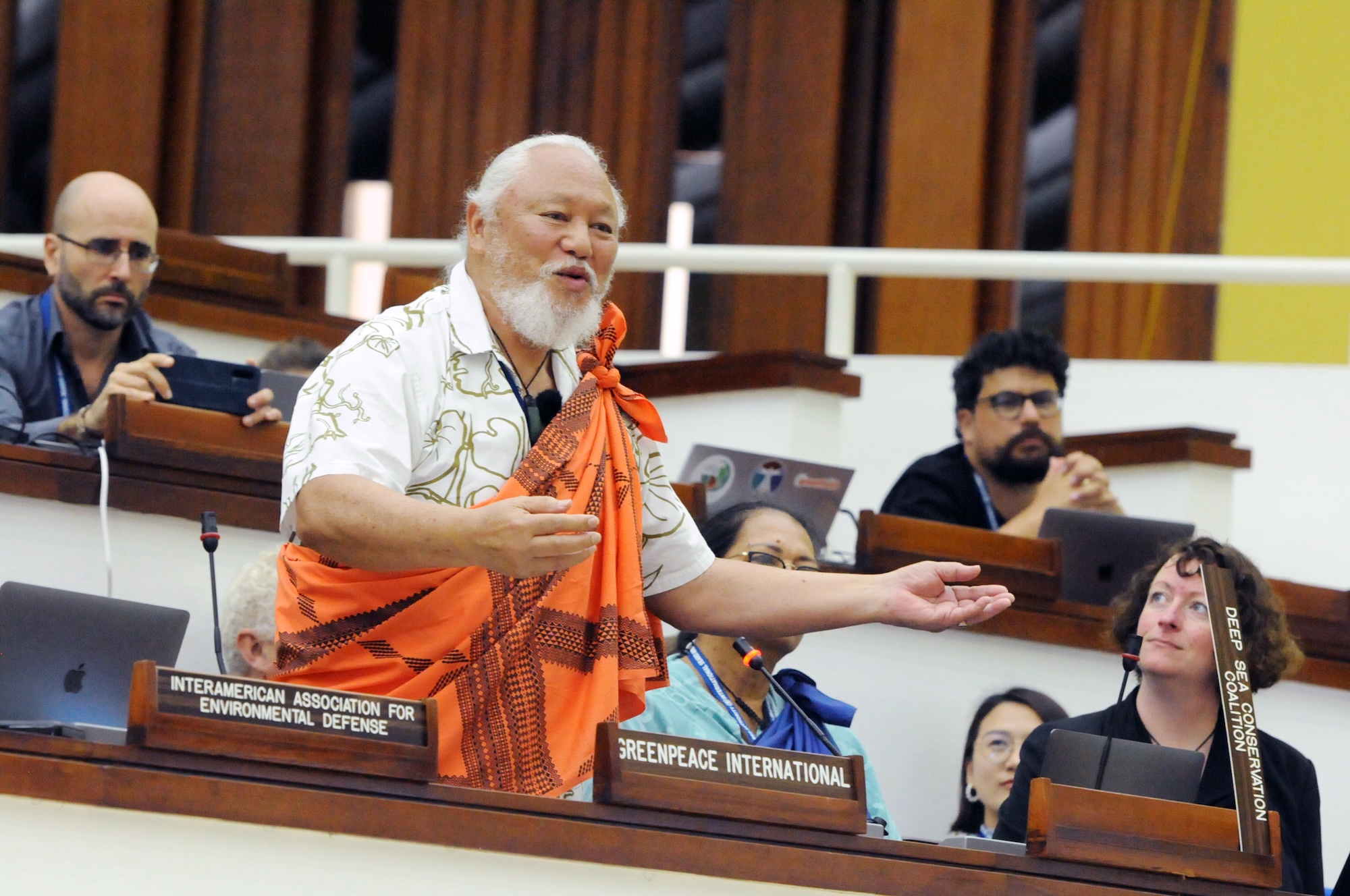
Image: “Solomon “Uncle Sol” Kaho‘ohalahala, Maunalei Ahupua‘a/Maui Nui Makai Network, offers a Hawaiian oli (chant) about people who came from very far having the opportunity to speak to each other, reminding delegates of the cultural significance of the Ocean.” IISD/ENB
Discussions at the ISA by States parties tend to be embroiled in diplomatic cloak and technical necessities. According to Emil W. Hildebrand, data reveals a sheer 43% of the first 4 days were spent on opening statements during the ISA Assembly with many items on the agenda repeated from the ISA Council. What this doesn’t reveal is behind the scenes, invisible yet frenzied intellectual and physical labor that pours into capacity building workshops, campaigns and advocacy efforts on the ground.
The days are heavily packed (including lunch breaks) in the long duree of intensive weeks – experts are rushed in to offer their takes, agendas are set among civil society groups and contractors quietly pop up among State delegates’ seats. Sometimes emotions run high, other times exhilaration wicker, taking a toll on physical and mental wellbeing. Pacific Indigenous participation as Observers has been growing from 2023 and making headway for the recognition of Indigenous participation and Underwater Cultural Heritage. Jamaica’s own role as a contractor blinds local Jamaicans who have little agency in these ‘high level’ meetings, let alone literacy of what such campaigns bring (when they pop up) to their daily busy lives.
This year at ISA’s 31st Assembly, an interim decision for contractors’ participation as observers tipped in their favour – not what was expected from the concluding ISA Assembly discussions. It signals a shifting balance of influence at the ISA. Yet the politics of participation at the ISA are not moving in only one direction. Through organised campaigns on the ground, civil society’s role has become increasingly significant in building a social and political momentum towards a moratorium, precautionary pause, or ban on deep-sea mining. As Pradeep Arjan Singh indicates, a moratorium is not a new wave and has been a favorable move among States in the history of the law of the sea and ocean governance. Today, more than forty states have called for one of these measures. Amid this momentum, and as critical reflections continue to unfold around the ISA and its regulatory regime, Deep Currents Collective (DCC) was granted an Observer Status and now officially contributes to this growing movement.
Even with the rising NGOs numbers – the role of culture, epistemic diversity and marine social sciences significantly suffers at the ISA whilst locals are left out of these important conservations.
The late Elizabeth Mann Borgese once said, “[t]he ocean is a medium different from the earth: so different, in fact, that it forces us to think differently”. Inspired by Borgese, thinking through the ocean’s medium and tying it with the realm of art holds a special space in DCC’s vision and practice. Adjacent to the ISA sessions, DCC also reflects on its past year’s (July 2025) three-week exhibition Our Collective Seabed at the National Gallery of Jamaica in Kingston. Organised by DCC together with co-curators O’Neil Lawrence (Chief Curator) and Monique Davis-Barnett (Senior Curator), it was a locally grounded intervention open to the wider public. This event and exhibition foregrounded Caribbean perspectives, where one could pause and reflect, enjoy glimpsing into the museum’s collection, alongside curated works of international artists that opened for the first time in the space. DCC’s collaboration with the museum brought timely and critical attention to deep ocean governance and deep-sea mining, demonstrating how one could meaningfully contribute to conversations beyond the formal negotiating rooms of the ISA.
Author: Mekhala Dave
Image credit: Photo by IISD/ENB