
A Milestone for the Deep Currents Collective
The Deep Currents Collective is an international group of scholars, lawyers, artists and community activists focussed on ocean governance approaches that deliver better outcomes for the ocean and the human and other communities that depend on it. The Collective recently gained official Observer status at the International Seabed Authority (ISA). Dr Mekhala Dave reports on some of Collective’s activities at the ISA and their efforts to bring a more just, cultural focus to deep seabed governance.
Accredited Observers at the International Seabed Authority
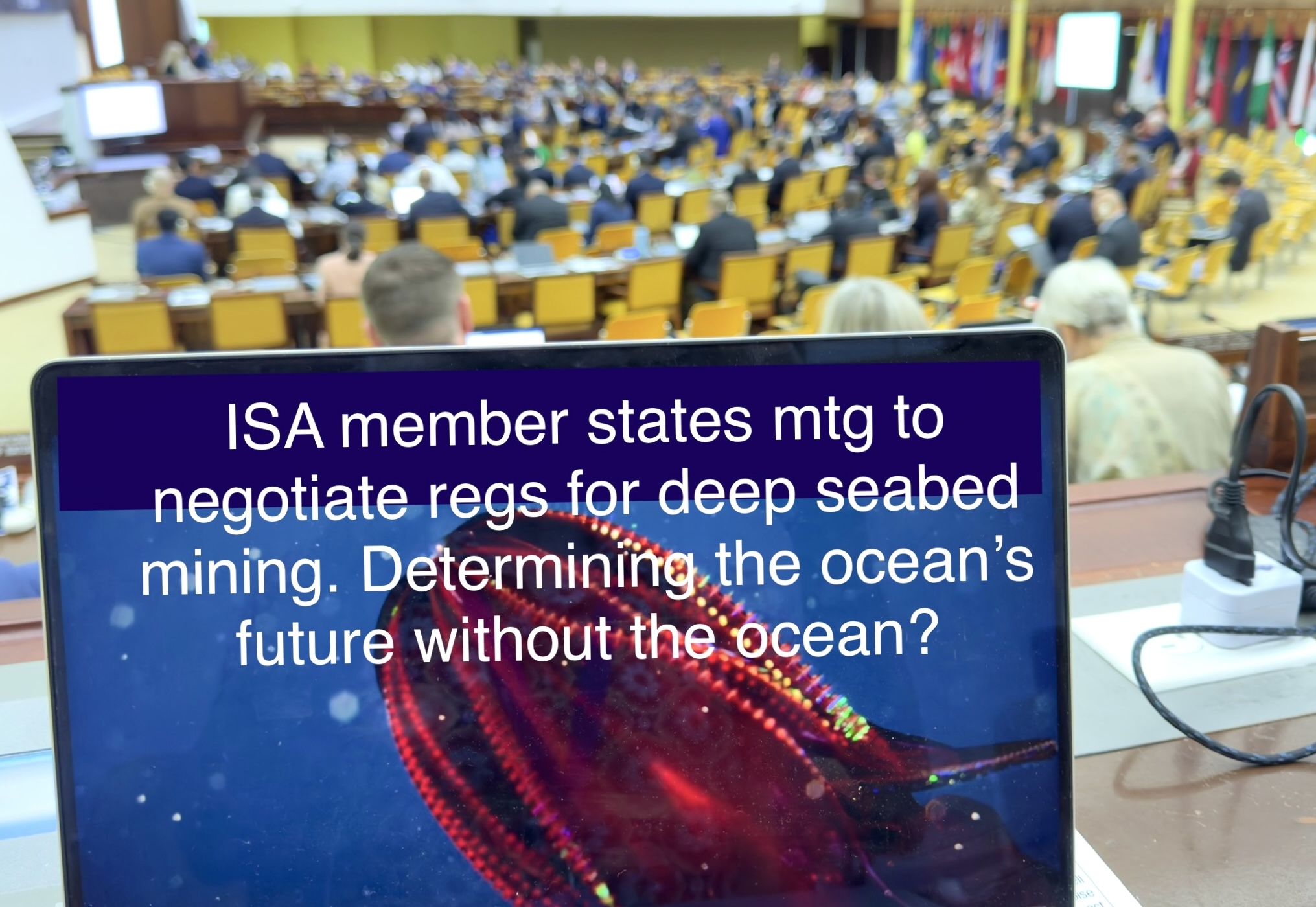
Deep Currents Collective (DCC) members have been attending the International Seabed Authority (ISA) sessions in Kingston, Jamaica, over the past several years. On 31 July 2026, during the 31st Assembly Session, Deep Currents was granted official Observer Status at the ISA.
The ISA is carving rules to regulate the international deep seabed for potential deep seabed mining of polymetallic nodules in the Clarion-Clipperton Zone (CCZ) of the Pacific Ocean. Meeting biannually in Kingston Jamaica, it brings together States, civil society groups, Indigenous peoples and industry representatives. The least understood deep ocean reaches sunless depths, and at present, the ISA and stakeholders alike are piecing together different knowledge to determine the Common Heritage of (Hu)mankind – a legal principle for sharing of benefits from potential mining activities. The Observer Status is a remarkable milestone considering DCC’s early years of contributing at the ISA through another observer organisation, TBA21. While Observer Status does not come with guaranteed resources to support this work, it does allow DCC to engage independently and to foreground cultural perspectives through an interdisciplinary approach.
“Seabed governance’s long, slow, fall from its redistributive conception underscores that we cannot rely on help to arrive from above. It is up to us to look beyond the guardrails for places where they might be widened or reshaped.”
— An Abyssal Conversation, Deep Currents Collective (2025)1
As the ISA advances on regulating the deep seabed, challenges arise on questions of benefit-sharing of resources. These include whether mining is feasible and could it be insured against potential damages? Or how might processing operationalise, and minerals be equitably distributed? Are they alternatives to fossil fuels for an energy transition? Could the ISA really strike a balance in its task to mine the deep seabed whilst establishing thresholds of harm to protect the marine environment?
The more-than-human, socio-cultural and marine social sciences are critical to understand governing the deep seabed. These perspectives remain among the least recognised within discussions on the deep seabed and resource extraction at the ISA. They are rarely approached as openings for conceptual work, critique, or both. Consequently, little attention is given to how cultural perspectives question the ontological foundations of the international ocean regime anchored by the law of the sea. DCC recognise this gap and advocate for greater epistemic diversity and encourage local grassroots practice. An Observer Status enables DCC to bring historical and cultural analysis into collective decision-making while advocating for open science, transparency in law-making, equitable and broad benefit-sharing, and meaningful Indigenous representation. By bringing together the expertise of its members across disciplines, DCC can engage directly in the ISA proceedings and contribute to shaping the Common Heritage of (Hu)mankind. For now, DCC’s Observer Status is not an end in itself. It is an opportunity to weave multiple meanings, catalyse fresh takes and deepen cultural participation for the deep ocean.
Author: Mekhala Dave, Deep Currents Collective
Image credit: Susan Reid
- Champion, G., DeLoughrey, E., Dave, M., Galka, J., Limpo, A., Reid, S., & Stewart, K. (2025). The Deep Currents Collective: An Abyssal Conversation. Comparative Law Journal of the Pacific, (XXV111). ↩︎