
Ghost Nets: Creative Re-purposing*
Across the world, infrastructures of resistance and care come together to counter and clean up after extractive regimes.
Not-for-profits and other agencies respond by gathering evidence, raising awareness, developing resources, lobbying for regulatory change, and taking direct action such as rescuing stranded animals, retrieving extractive capitalist discards from beaches, exploring re-use options for retrieved materials, and protest. In the case of ghost nets dumped by commercial fishers, there’s Global Ghost Gear Initiative and UNEP, and in Australia government agencies such as Parks Australia and university initiatives such as the UNSW SMaRT Centre.
The multibeing ocean is a significant part of such counter infrastructures. They survive, recover, and regenerate (where they can) from the impacts of extractive fisheries. As an example, in northern Australia, tons of dangerous ghost nets drift into the Gulf of Carpentaria, carried by currents in the Arafura and Timor Seas, and strong tides. While the Gulf is a hot spot for derelict nets, the ocean also washes the nets onto the islands of the Torres Strait such as Erub and Darnley
Local communities, Indigenous rangers, the Australian Navy, Parks and Wildlife Services, artists, and others contribute, at different times to retrieve ghost nets from the ocean and those buried in the sand. Responding to the wastes of industry, together they contribute to a counter infrastructure of care. Indigenous communities located in northern Australia and the Torres Strait Islands bear witness to the extractive capitalist waste damaging SeaCountry.
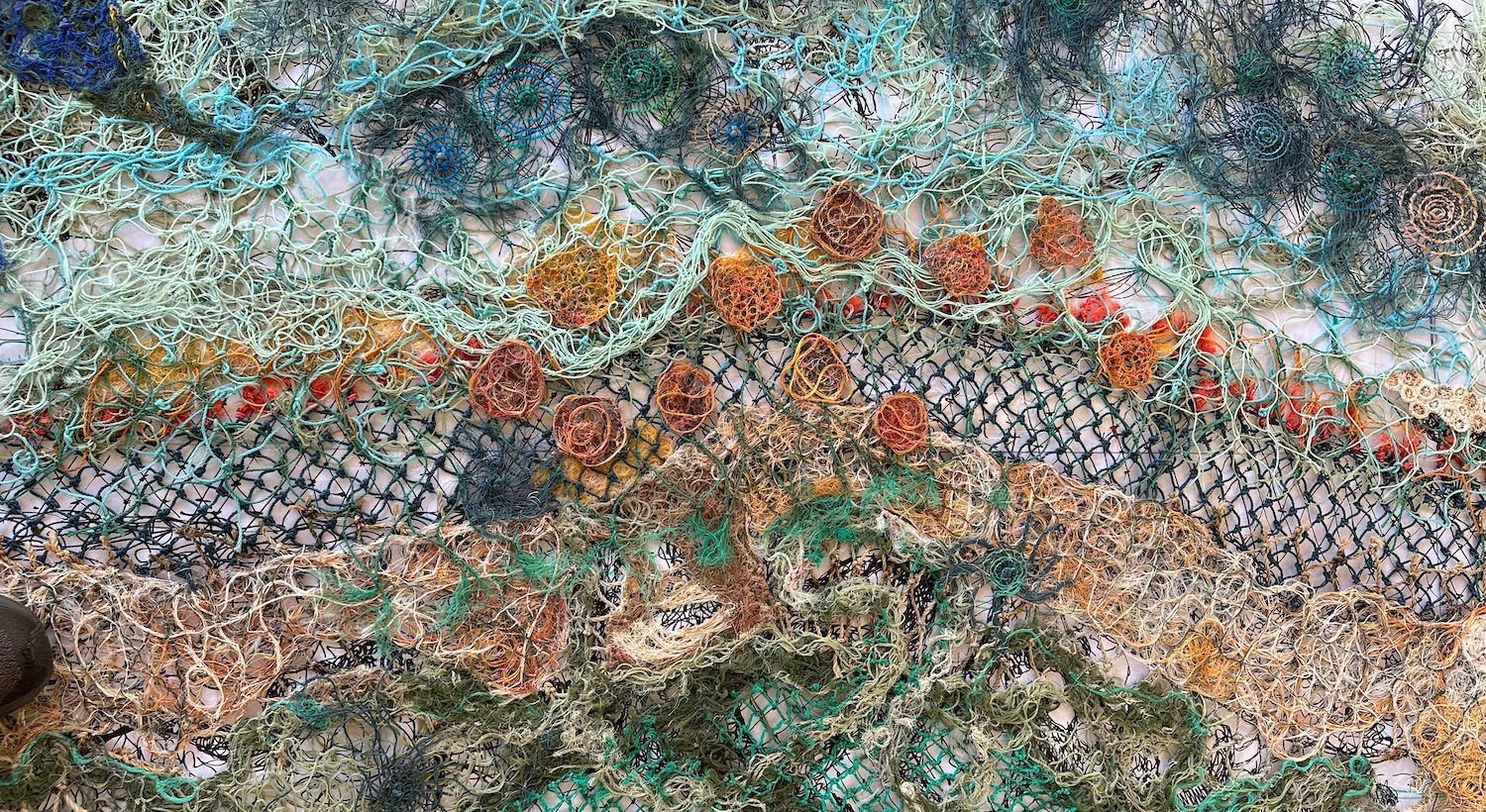
Perhaps the best known and most creative use of derelict nets is in ghost net art, made by Indigenous communities to share stories of the sea and culture, while raising public awareness of the dangers of ghost nets. Turning destructive material into vibrant, beautiful art works is a generative practice of caring for the land and ocean. Ghost net works by Indigenous artists, sometimes made in collaboration with the cross-cultural group the Ghost Net Collective, have been commissioned and exhibited nationally and internationally.
Ghost nets are retrieved and, where they are not too degraded, re-used in a range of ways. In Northern Australia, some Indigenous communities use them to screen verandas, fence chicken pens, and for making fishing and yam bags.[i] At a different scale, certain manufacturing industries too are turning their attention to ways of re-using recycled fishing nets. For example, in 2025, the BMW Group plans to launch the NEUE KLASSE model of car which will features trim parts made from 30% recycled fishing nets and ropes.
*Republished from Extracting the Ocean. Reid, S. (2023). Derelict Nets as Proxy Predators.
Image detail: “Ngarna Ngarruwa Karuma Ngarrawadanguma enena-manja Akuwaduwada: Binding the land together” artwork created by Ghost Net Collective and Anindilyakwa Arts for the Groote Eylandt Project, Binding the Land Together, South32 Perth Office Art Program 2025.
Image source: Ghost Net Collective: https://www.ghostnetcollective.com.au/groote-ey.
[i] TierraMar, and SMaRT@UNSW. 2021. “Ghost Nets. Needs Analysis and Feasibility Study for Northern Australia, Final Report.” Sutherland, 30.