
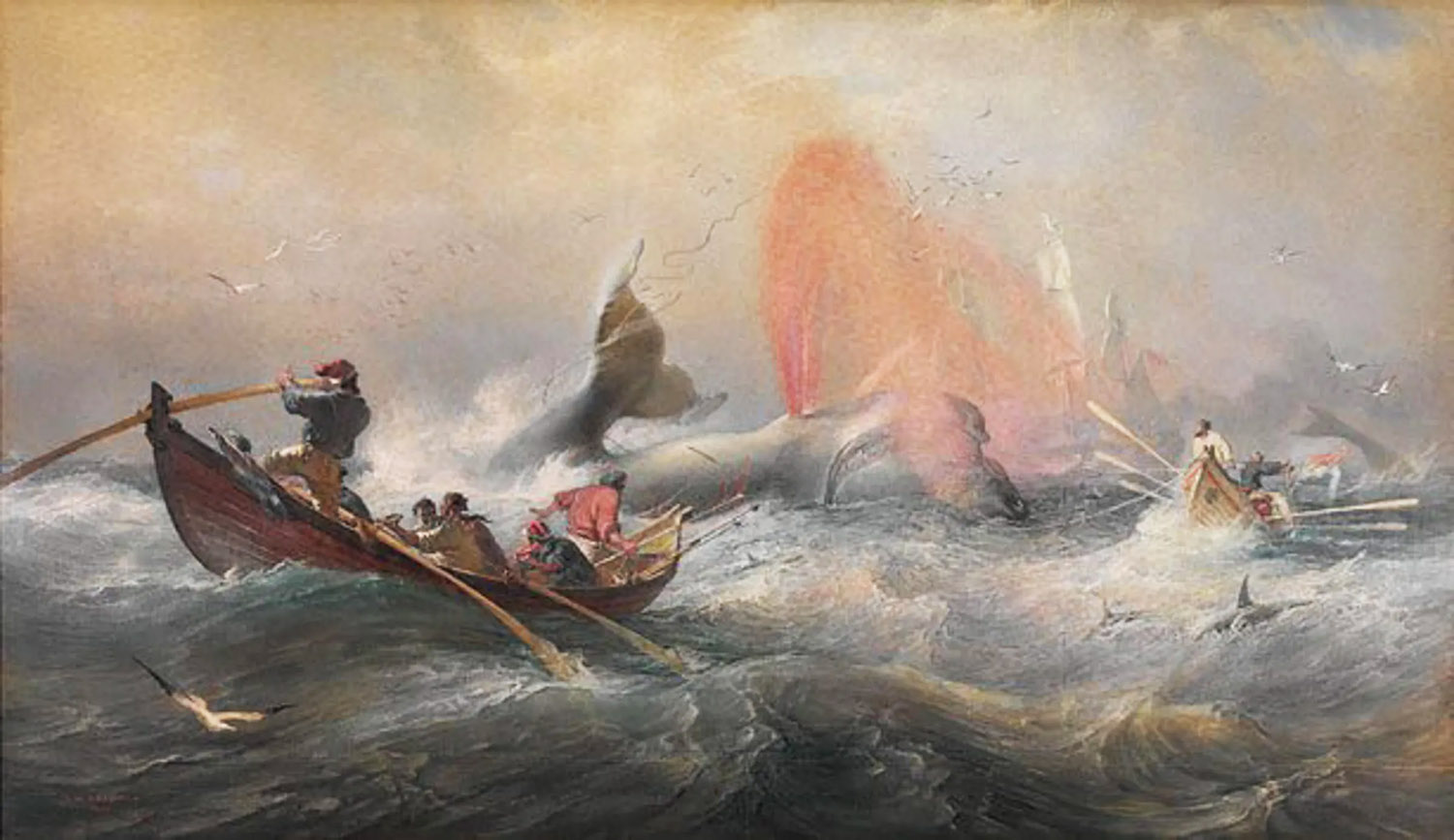
Whale slaughter
Commercial whaling was one of the most profitable extractive industries ever undertaken.
Until commercial whaling finally ended with the 1982 moratorium, the whaling industry killed, and hauled body after massive body of long-lived, soniferous beings from the seas. As Holmes writes, ‘[w]haling was one of the most profitable extractive industries ever undertaken (…)
It was likely the one activity that impacted life in the oceans more than any other single pre-industrial activity’.[i]
Whales have been killed, and their blubber eaten and melted down for centuries. From the eighteenth century, their blubber lubricated developing European and North American economies and industry.[ii] As whaling became a profitable industry for these nations, Indigenous peoples lost them as a vital source of sustenance and an important cultural presence. North American and Russian whalers led the slaughters in the northern hemisphere. During the eighteenth and nineteenth centuries, hunters preyed on slower whales such as the sperm, bow, right and humpback. Yankee whalers and others chased, exhausted and killed these giants using just open, wooden boats.[iii] By 1875, commercial whalers had killed 13,0000 bowheads using these simple means.[iv] Between 1712 and 1899, an estimated 300,000 sperm whales were killed globally.[v] At this time, some of the slower whales could escape to the icy regions above forty degrees north;[vi] the faster ones could still outswim the whalers.
The above accounts concern whale killings in which the whale bodies were ‘processed’ and brought to shore. A recent study shows that the number of whales lost in the earlier stages of the industry was actually much higher. Scientists examined whaling log books for the Southern Atlantic Ocean, to identify how many whales were struck but lost between 1776 and 1923. They found that some whales were killed but sank and others were struck but likely died at sea. Whether those whales struck and lost actually died is not certain. However, those “reported to be “spouting blood” or to have “drowned” after being struck” likely died.[vii] For every ten southern right whales killed and brought to shore, five were lost to sea; for every ten sperm whales, one was lost.[viii]
Image caption: Whalers off Twofold Bay, New South Wales, 1867. rtist: Oswald Walters Brierly
Source: Art Gallery of NSW
[i] Holm, Poul, Anne Husum Marboe, Bo Poulsen, and Brian R. MacKenzie. 2010. “Marine Animal Populations: A New Look Back in Time.” In Life in the World’s Oceans, 1–24. John Wiley & Sons, Ltd.: 16.
[ii] Demuth, Bathsheba. 2019. Floating Coast. An Environmental History of the Bering Strait. Norton & Company: 28; Josephson, Elizabeth A., Tim D. Smith, and Randall R. Reeves. 2007. “Depletion within a Decade: The American 19th-Century North Pacific Right Whale Fishery.” In Oceans Past. Routledge: 109.
[iii] Starkey, David J., Tim D. Smith, and Michaela Barnard. 2011. “Fisheries and Marine Animal Populations: Learning from the Long Term.” PloS One 6 (2): 5.
[iv] n 2: 54.
[v] Smith, Craig R., Lisa A. Levin, Anthony Koslow, Paul A. Tyler, and Adrian G. Glover. 2008. “The near Future of the Deep-Sea Floor Ecosystems.” In Aquatic Ecosystems: Trends and Global Prospects, edited by Nicholas V. C. Polunin. Cambridge University Press.
[vi] n3: 5.
[vii] Vighi, Morgana, Asunción Borrell, Jennifer A Jackson, Emma L Carroll, Maria Grazia Pennino, and Alex Aguilar. 2020. “Missing Whales: Relevance of ‘Struck and Lost’ Rates for the Impact Assessment of Historical Whaling in the Southwestern Atlantic Ocean.” ICES Journal of Marine Science 78 (1): 14–24.
[viii] ibid