
Fathoming the Scale of Extraction*
In their routine reports on global fisheries catches, the Food and Agriculture Organisation (FAO) normalises staggering levels of human predation.
They estimate that 78.8 million tonnes (mt) of ‘wild caught’ fish were hauled from the sea, in 2020.[1] This is forecast to increase to 96 mt by 2030.[2] These are the known and reported numbers of animals taken–many more went unreported.
Human consumption of marine animals has doubled in the last fifty years and will likely increase by 15 percent by 2030.[3] While having no direct oversight of global fisheries, the FAO is responsible for promoting the industry and ensuring its ongoing growth. In its recent campaign, the FAO represents expansion of industrial fisheries as a ‘blue transition’ and justifies increases as necessary to feed growing human populations. [4] It is relatively silent on the numbers of marine animals killed to also feed the bodies of human companion species, or to be reconstituted as fish meal to feed ‘livestock’, or those rendered as waste.
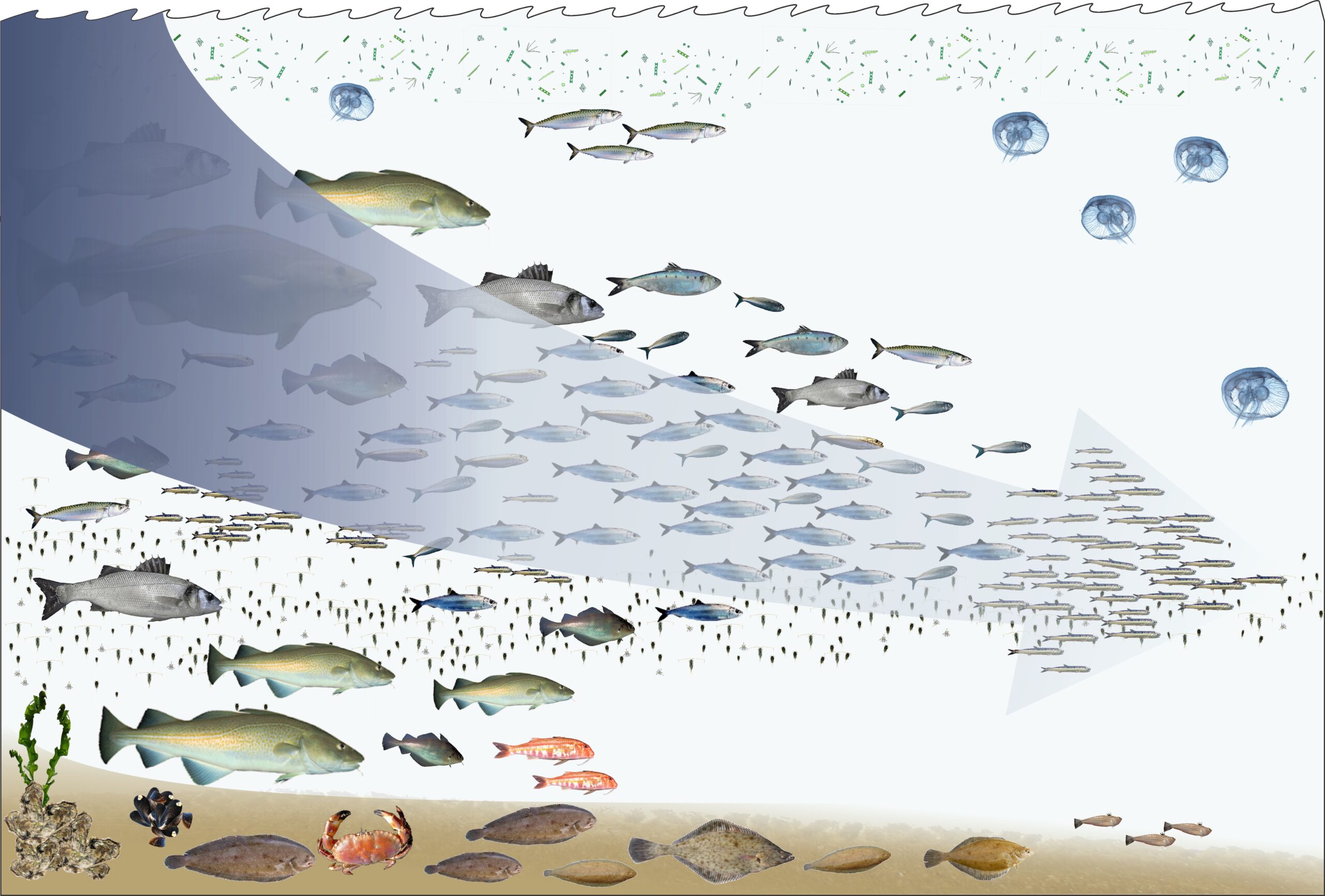
For decades, marine biologist Daniel Pauly has highlighted how scientists and fisheries managers such as the Regional Fisheries Management Organisations, grossly underestimate the decline of fish populations. Pauly argues that estimates of fish population numbers are routinely compared to late twentieth century baselines but, in fact, humans have been ‘fishing down the food web’ for decades and centuries earlier.[5] It wasn’t until the 1990s that scientists involved in the History of Marine Animal Populations (HMAP) project offered a documentary basis (albeit incomplete) for piecing together the scale of historic fisheries catches. With this material we can begin to imagine the magnitude of change from the ocean of past centuries.
* Adapted from: Extracting the Ocean. Reid, Susan. 2024. “Fathoming the Scale of Extraction.” Extracting the Ocean.
Image Credit: Photographer: Hans Hillewaert. “Fishing down the food web, a North Sea perspective.”Inspired by the work of Daniel Pauly.
[1] FAO. 2022. The State of World Fisheries and Aquaculture 2022: Towards Blue Transformation. The State of World Fisheries and Aquaculture (SOFIA) 2022. FAO: vxii.
[2] n 2, xxv
[3] n 2, vxii
[4] FAO. 2022
[5] See: Pauly, Daniel. 1995. “Anecdotes and the Shifting Baseline Syndrome of Fisheries.” Trends in Ecology & Evolution (Amsterdam) (England) 10 (10): 430–430; Pauly, D. 2019. Vanishing Fish: Shifting Baselines and the Future of Global Fisheries. With Jennifer Jacquet and David Suzuki Institute. David Suzuki Institute; Watson, Reg A., and Daniel Pauly. 2013. “The Changing Face of Global Fisheries—The 1950s vs. the 2000s.” Marine Policy 42 (November): 1–4; Probyn, Elspeth. 2016. Eating the Ocean. Duke University Press.