
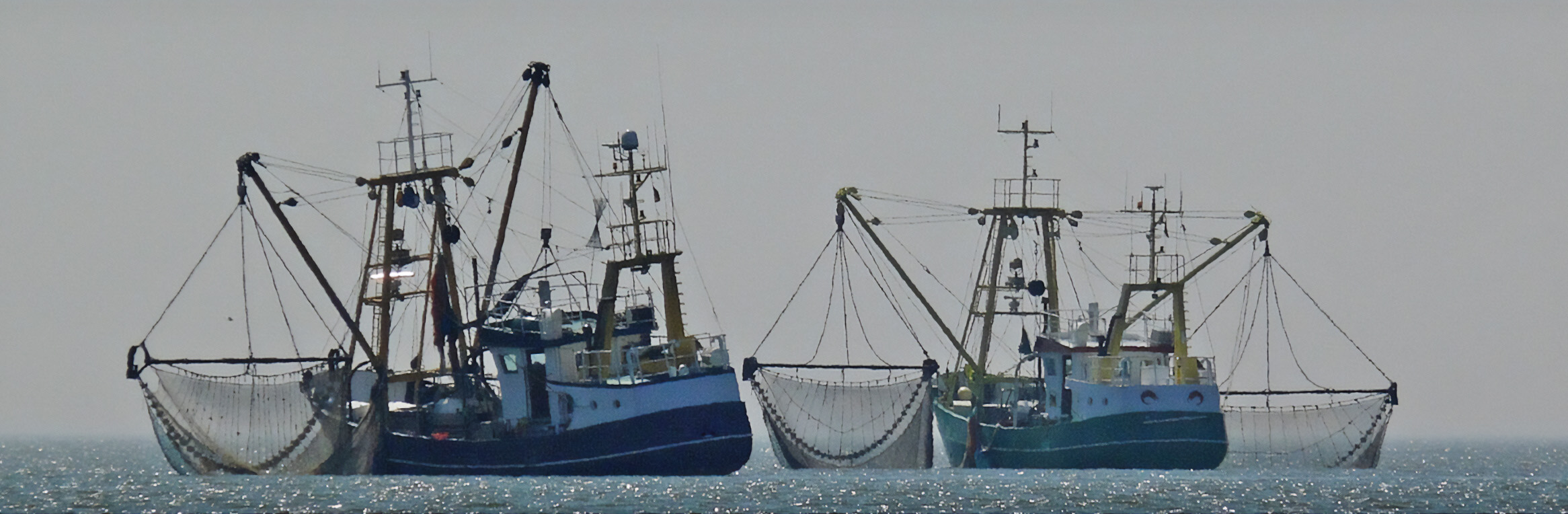
Marine Animal Extraction: 20th Century Intensification*
Human predation on marine beings increased exponentially from the industrialised 1900s. Myers and Worm estimate that the ‘biomass’ of large predatory fish is now only 10% of pre-industrial levels.[1] This trending decline in marine animal populations, commonly measured through the unfortunate and generalised term of ‘biomass’, is evident across a range of data samples and time periods. The North Atlantic has seen a two-thirds decline of the biomass of high trophic fish species since the 1950s;[2] large fish have declined between 97 percent and 99 percent in the North Sea.[3] From the commencement of baseline surveys in 1961, the number of large fish declined in South Georgia (84 percent), eastern Canada (90-92 percent), and on the South-east Australian shelf 91 percent.[4] The Gulf of Thailand has lost 86 percent of its overall fishing biomass and 91 percent of its predatory fish.[5] In the Benguela Current ecosystem of Southwest Africa, large, accessible species were intensely exploited prior to the 1900s.[6] Over the past 200 years, 50 million ton (mt) of biomass has been removed, reaching more than one mt per annum in the 1960s.[7]
Marine biologists, Joseph Christensen and Malcolm Tull detail the severe impacts to marine animal populations across South East Asia and the Indo Pacific since the 1900s.[8] The numbers of fish killed within national and EEZ waters, between 1950 and 1980: ‘increased by factors of three in Japan and India, four in Australia, Malaysia, and Bangladesh, five in Sri Lanka, six in the Philippines and Papua New Guinea, more than ten in Thailand and Burma, and several Pacific Island nations, and, most spectacularly, twenty in Indonesia’.[9]
Following the war, industrial fisheries intensified across the Central Indo-Pacific, supported by national programs such as India’s ‘Blue Revolution’, which began in 1951.[10] Similar programs to boost capture fisheries commenced in Sri Lanka in the 1960s and 1970s, and across Pacific Island nations. [11] Between 1950 and 2000 the fishing fleets of Asia and Oceania increased their recorded marine catches by 422 percent and 1,218 percent respectively, against a global average of 344 percent 14).[12]
*Text adapted from: Extracting the Ocean. Reid, Susan. 2023. “20th Century Intensification of Marine Animal Extractions.” Extracting the Ocean, February 12.
Image Credit: South Pacific Regional Fisheries Management Organisation
[1] Myers, Ransom A., and Boris Worm. 2003. “Rapid Worldwide Depletion of Predatory Fish Communities.” Nature (London) 423 (6937): 280–83.
[2] Christensen, Villy, Sylvie Guénette, Johanna J. Heymans, et al. 2003. “Hundred-Year Decline of North Atlantic Predatory Fishes.” Fish and Fisheries (Oxford, England) (Oxford, UK) 4 (1): 1–24.
[3] Jennings, Simon, and Julia L. Blanchard. 2004. “Fish Abundance with No Fishing: Predictions Based on Macroecological Theory.” The Journal of Animal Ecology 73 (4): 632–42.
[4] Lotze, Heike K., and Boris Worm. 2009. “Historical Baselines for Large Marine Animals.” Trends in Ecology & Evolution (Amsterdam) (Kidlington) 24 (5): 254–62.
[5] ibid.
[6] Griffiths, C. L., L. Van Sittert, P. B. Best, A. C. Brown, B. M. Clark, P. A. Cook, R. J. M. Crawford, et al. 2005. Impacts of Human Activities on Marine Animal Life in the Benguela: A Historical Overview. Vol. 42: 303.
[7] ibid.
[8] Christensen, Joseph, and Malcolm Tull. 2014. Historical Perspectives of Fisheries Exploitation in the Indo-Pacific. 2014th, 1st ed. 2014. ed. Vol. 12. MARE Publication Series. Dordrecht: Springer Netherlands.
[9] n 9, 30.
[10] n 9, 25-26.
[11] n 9, 26.
[12] ibid.