
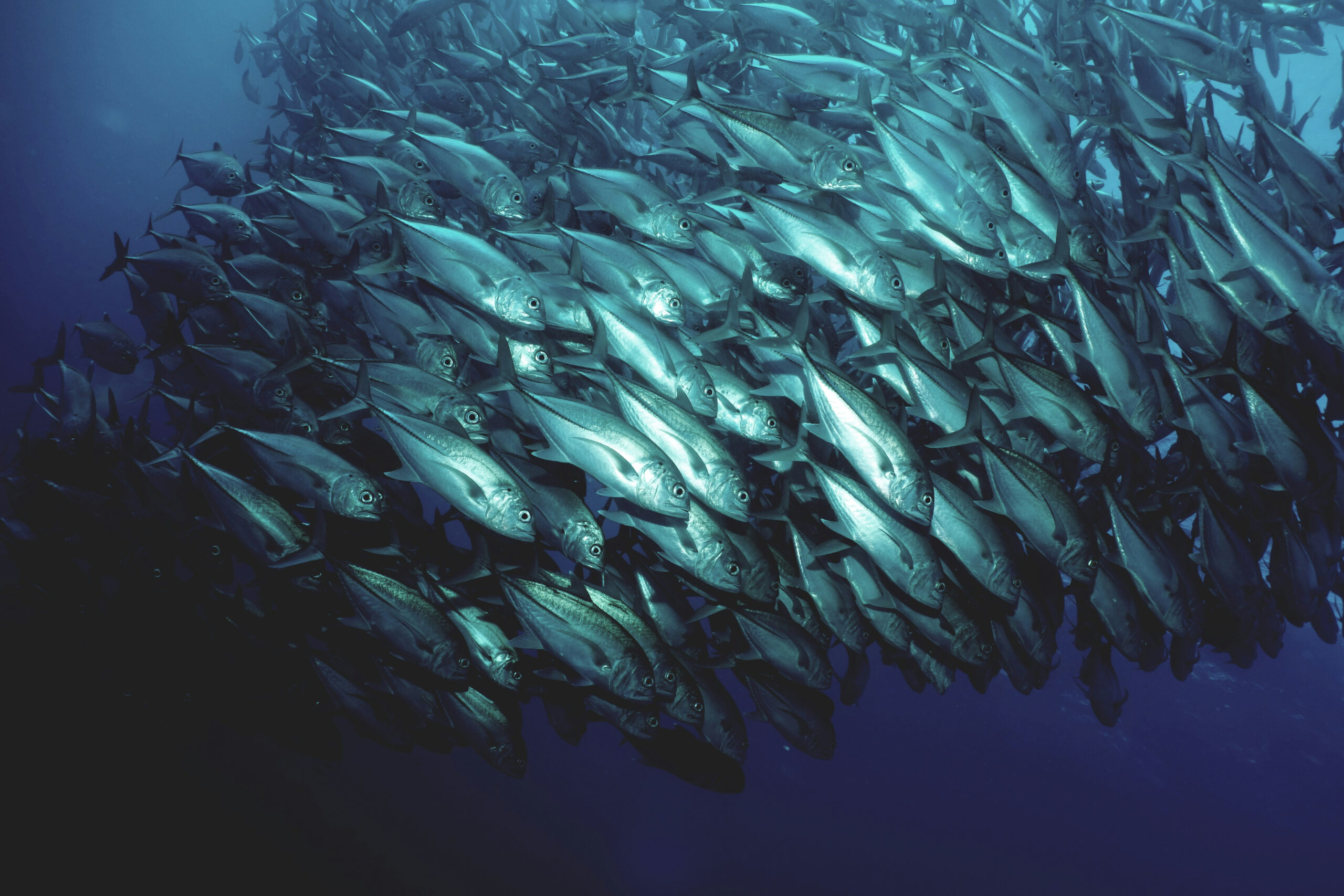
Historic Decline of Pre-industrial Fisheries: Northern Hemisphere
HMAP[1] researchers measured the number of marine animals taken from the ocean over centuries of fishing and whaling activity. In the case of the northern hemisphere, researchers gleaned historic data from available log books, national archives, taxation records, maps and even cookbooks. Not all catches were documented or declared and historic data about the marine animal populations of several regions is not yet available). Nevertheless, existing historical records unambiguously reveal a pattern of unrelenting, human predation on marine animals that paused only for the world wars.
Even without fossil-fuel powered technologies, pre-industrial fishers significantly impacted marine life just using wind power, drift nets and lines.[2] By the middle ages commercial fisheries in Europe were already well established.[3] Across the northern hemisphere, the extraction of marine animals intensified to feed growing European and North American populations and economies, and to satiate consumer trends.[4] In the northern hemisphere, targeted fish populations in the 1600s were ten times more abundant than in the 1950s and had already significantly declined by the 1800s.[5] As examples, historic catch levels across the northern hemisphere include:
- Tuna stocks in the Mediterranean declined 60 percent between 1650 to 1950.[6]
- Catches of haddock from the Danish Wadden Sea were 1200 mt from 1562 until mid 1600s then dropped to 500 metric tonnes by the eighteenth century, to non-existent today.[7]
- Haddock, salmon, shad, and sturgeon were extirpated from the North Sea in the nineteenth and twentieth centuries.[8]
- In the Northeast Atlantic, the combined efforts of British and French fishermen on the Grand Banks off Newfoundland yielded between 204,000 and 275,000 mt of cod between 1769 to 1774,[9] up to 300,000 mt by the late 19th century.[10]
- Closer to the American mainland, fisheries off the Gulf of Maine and Scotian Shelf consistently removed 200,000 mt of live fish per year between 1852 – 1866.[11]
[1] The History of Marine Animal Population (HMAP) was the historical component of the Census of Marine Life.
[2] Holm, P. (2005). Human impacts on fisheries resources and abundance in the Danish Wadden Sea, c1520 to the present. Helgoland Marine Research, 59(1), 39–44: 9
[3] Starkey, D. J., Smith, T. D., & Barnard, M. (2011). Fisheries and Marine Animal Populations: Learning from the Long Term. PloS One, 6(2): 4.
[4] Starkey and Barnard identified that, for example, consumption of marine animals increased in part because of the religious practices of eating fish on certain weekdays and during the forty days of Lent, which lasted well into the seventeenth century. See n 2.
[5] Holm, P. (2005). Human impacts on fisheries resources and abundance in the Danish Wadden Sea, c1520 to the present. Helgoland Marine Research, 59(1), 39–44: 9
[6] Ravier, C., & Fromentin, J.-M. (2004). Are the long-term fluctuations in Atlantic bluefin tuna (Thunnus thynnus) population related to environmental changes? Fisheries Oceanography, 13(3), 145–160, cited in Lotze, Heike K., and Boris Worm. 2009. “Historical Baselines for Large Marine Animals.” Trends in Ecology & Evolution (Amsterdam) 24 (5): 254–62: 256.
[7] Lotze, Heike K., and Boris Worm. 2009. “Historical Baselines for Large Marine Animals.” Trends in Ecology & Evolution (Amsterdam) 24 (5): 254–62: 256.
[8] Lotze, Heike K., and Boris Worm. 2009. “Historical Baselines for Large Marine Animals.” Trends in Ecology & Evolution (Amsterdam) 24 (5): 254–62: 256.
[9] Starkey, D.J. & Haines, M. (2001) The Newfoundland fisheries, c. 1500–1900: a British perspective. In: The Exploited Seas: New Directions for Marine Environmental History (eds. P. Holm et al.), pp. 1–11.
[10] Cadigan, S.T. & Hutchings, J.A. (2001) Nineteenth-century expansion of the Newfoundland fishery for Atlantic cod: an exploration of underlying causes. In: The Exploited Seas: New Directions for Marine Environmental History, Research in Maritime History, vol. 21 (eds. P. Holm, T.D. Smith & D.J. Starkey), pp. 31–65. St. John’s, Newfundland: International Maritime Economic History Association.
[11] Holm, Paul, Anne Husum Marboe, Bo Poulsen, and Brian R. MacKenzie. 2010. “Marine Animal Populations: A New Look Back in Time.” In Life in the World’s Oceans, 1–24. John Wiley & Sons, Ltd.: 12.